
| Price | Booth |
| Release | October 2, 2023 |
| Compatibility | NS2 / PC |
| Dimensions | 9.8″ x 5.9″ x 0.8″ |
| Weight | 1.76 lbs |
Introduction
Used by Omito (a Guilty Gear pro who won Evo multiple times), the Saya Arcade Shinogi is a mini, slim, and light leverless controller with 15 buttons.
“Shinogi” is a Japanese word that means the ridge line on a blade like the katana, and it separates the cutting edge from the flat part.
In other words, “shinogi” symbolizes sharpness, precision, and craftsmanship—signifying that the controller is a weapon for elite performers.
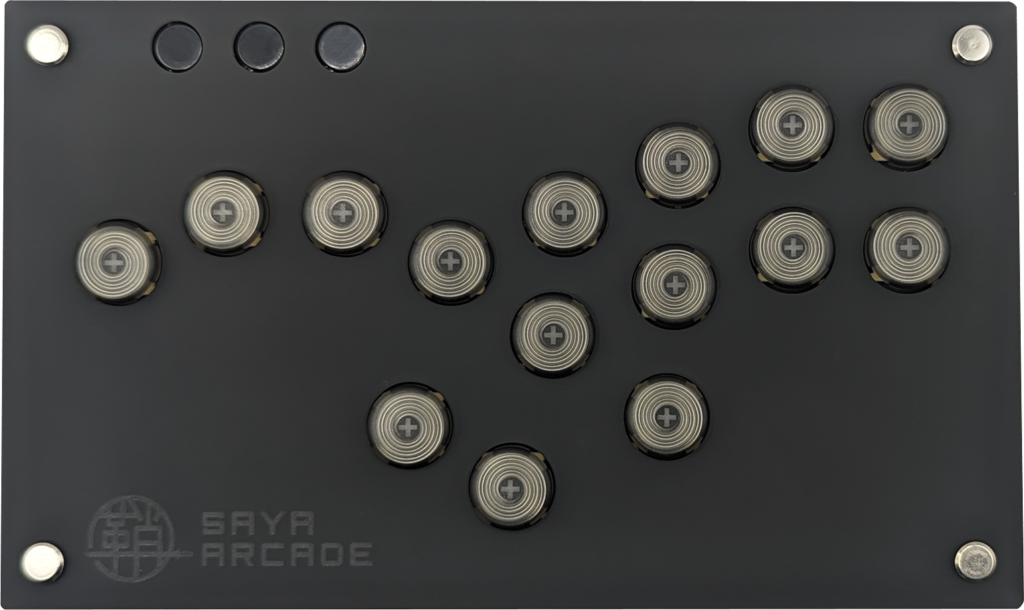
That said, there are a couple of extra buttons on the jump button’s sides to be used by your thumbs, and the Shinogi also has a left pinky button.
The Shinogi button layout’s main unique aspect is how the eight attack buttons are stacked diagonally. Also, the buttons have unique spacing between them, which may require getting used to—and may also end up being your preferred spacing. Finally, three function buttons can be found on the top panel.
Performance
The Tecsee switches that the Shinogi uses are yellow. They have a travel distance of 2.5 mm with a 1.3 mm actuation. As for the actuation force, it’s 50 g. In layman’s terms: these switches give you that crisp, tactile feedback that’s ideal for quick inputs.
In any case, you can replace the Tecsee switches with Cherry MX switches. Do note that low profile switches are not compatible with the Shinogi.
Otherwise, it’s worth noting that the way the Shinogi is built may be a reason why it’s quieter than average. Actually, let’s dive deeper into how this controller is built!
Hardware
The Shinogi is comprised of a lightweight combination of three plastics:
- Polycarbonate
- POM
- HPE
Polycarbonate is impact-resistant yet light, POM is what probably makes the Shinogi quieter, and HPE adds flexibility to the controller—without making it malleable.
Moving on, only four screws hold the Shinogi together. It’s a USB-C controller with the port conveniently being in the center back.
Regarding compatibility, the Shinogi utilizes the RP2040-Zero, so it runs on the open source and critically acclaimed GP2040-CE firmware.
The Shinogi’s firmware includes the SOCD cleaning modes of top priority and neutral. You can even turn off SOCD cleaning if you really want to.
Not only that, if you have a compatibility boosting dongle, you should be able to use it with the Shinogi to extend its compatibility with more consoles.
Appearance
The Shinogi’s color scheme of black and gray matches the Saya Arcade brand, such as if you check out its website. The polycarbonate adds a bit of gloss to the look too. In addition, the company’s logo is discreetly tucked into the top panel’s bottom left corner.
Because the Shinogi is put together by hand, you may see little scratches (or dust) on it, but don’t worry about that being overly noticeable or—perhaps more importantly—affecting performance.
Conclusion
If we were to recommend the Shinogi for one reason, it’d be because of its rare Tecsee switches.
- 15 buttons
- Tecsee switches
- MX compatible
- Unique layout
- Quieter usage
- Slim enclosure
- Smaller size
- Lightweight
- Plastic blend
- Only four screws
- Excellent firmware
- Extendable compatibility
- Sophisticated aesthetics
- Used by Omito
- Low profile switches incompatible
- May have scratches
Rating
⭐⭐⭐⭐⭐